All your equipment, one criterion.
VULKRON
Software for the EHS and maintenance teams of industrial plants: fire protection and electrical safety systems.
From the extinguisher to the fire pump and from the switchboard to arc flash, your people or your contractor inspect and sign off each asset from a phone, anything critical shows in red, and the PDF report comes out ready for the STPS or your insurer.
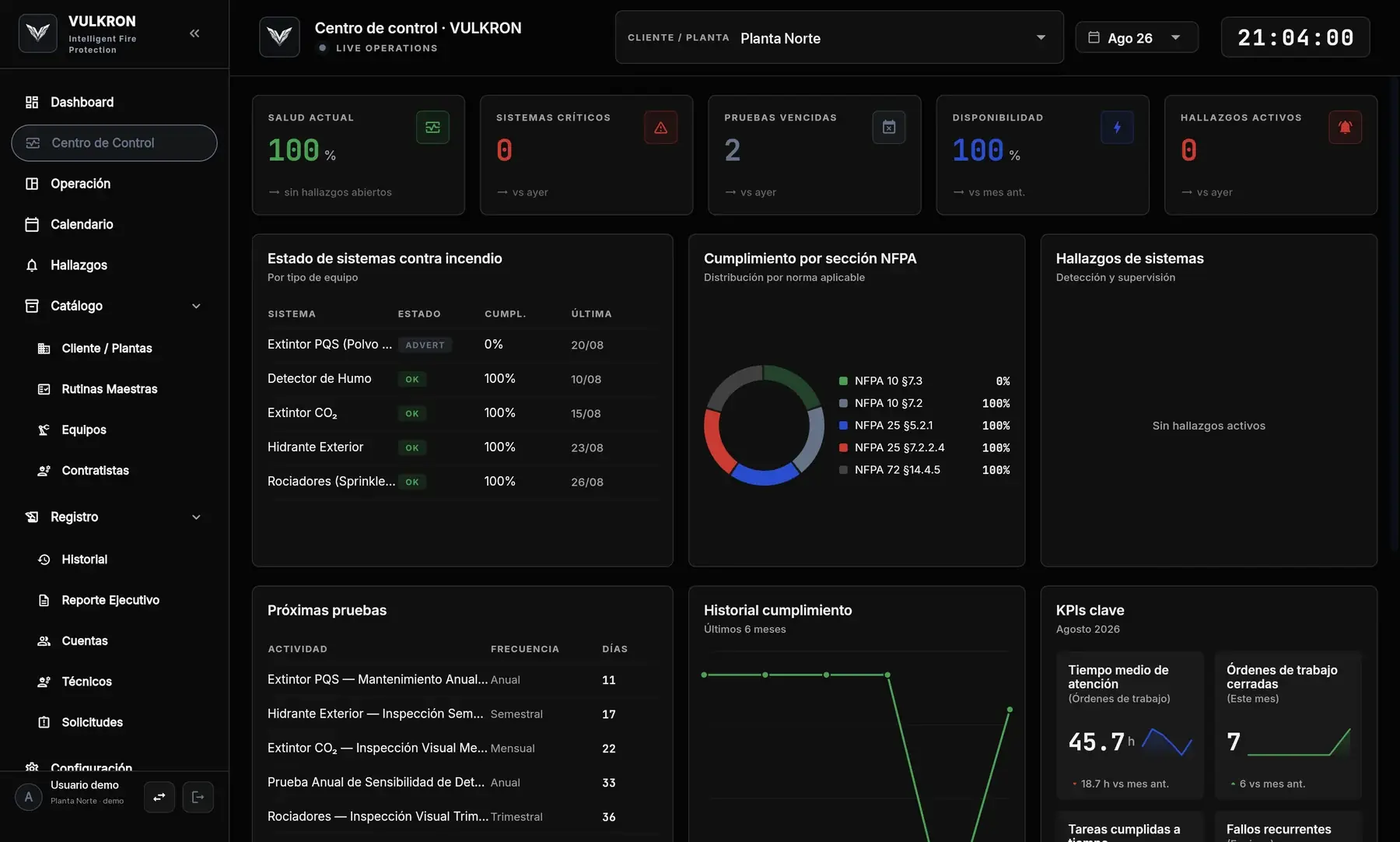
What do you need to solve?
The STPS asks for your inspection program and your records. With VULKRON, the record comes from daily work, and the PDF is ready the day they ask for it.
How the report is madeYour insurer inspects against its own criteria. Your routines follow the NFPA standards or, if your policy requires it, an insurer's standard such as FM Global.
How the criteria are setYour contractor joins at no cost and works with your plant's routine. You see what was done, what was flagged red and who signed.
Signing in the fieldAll your plants under the same criteria, and you see which one is up to date and which one has overdue equipment.
How per-plant quoting worksWhere every asset is, at a glance.
Your fire protection equipment on your plant's floor plan, in 3D: your people know which building and which spot each one is in.
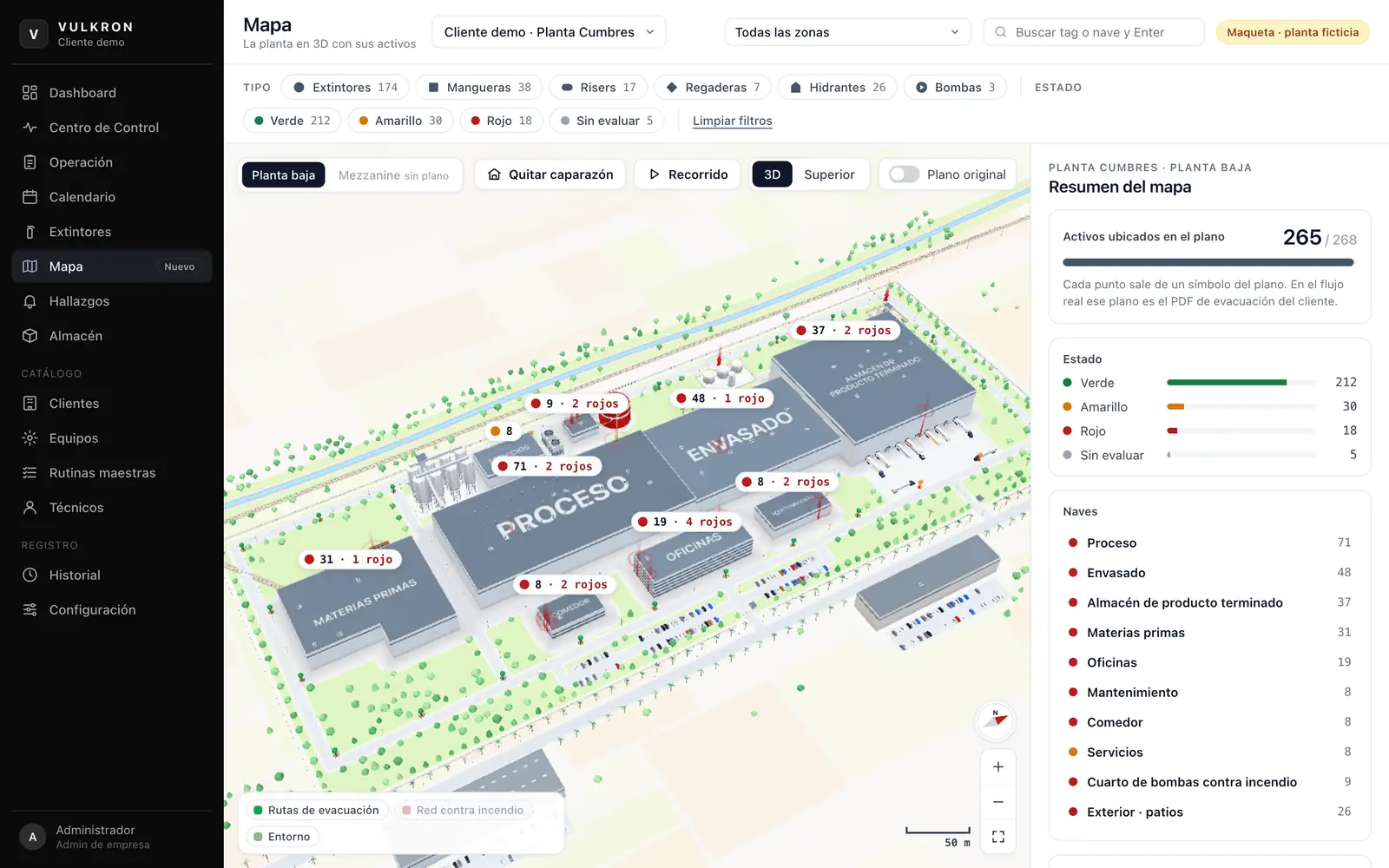
Anything red stands out at a distance, and one click opens the asset's details and logbook. The points come from your floor plan, one per symbol.
For your EHS team, what is VULKRON?











VULKRON is your software for fire protection and electrical systems.
It doesn't stop at extinguishers: it also covers pumps, sprinklers, hydrants, switchboards and arc flash.
Your plant sets the criteria: NOM, NFPA, European standards and whatever your insurer requires, even FM Global.
Your contractors work under the same criteria as your people, not with whatever format each one brings.
When the inspector arrives, each asset shows its logbook: what was found and who signed.
Which plants VULKRON is for.
Wherever there are fire protection systems and electrical installations that the STPS, an insurer or the corporate office reviews.
Hundreds of assets that cannot fail, and you have to prove they were checked.
In two minutes, VULKRON's co-founder describes a dangerous assumption: believing the risk is under control because maintenance was done. How do you prove it?
61%
of sprinkler failures in fires happened because the system was shut off.
12months
is how long, at least, a plant was shut down because its fire pump was left in manual mode after maintenance.
With VULKRON, the evidence builds up with every inspection and serves the STPS, your insurer and your corporate office alike: nobody has to put binders together before an inspection.
Sources: NFPA Research, “US Experience with Sprinklers” (Tucker and McGree, April 2024; United States, 2017 to 2021); Swiss Re Corporate Solutions, “Fire protection system impairment,” May 19, 2020. These are industry figures, not VULKRON results.
How it works, in three steps.
-
Master routinesLibrary of checklists by equipment type · applied to each maintenance work order+ New routineFire libraryClient / PlantsClients
- NPNorth Plant214 assets
- SPSouth Plant168 assets
- CPCentral Plant97 assets
Assigned routinesPlant scope. Adjusted for each plant without changing the master routine.+ Assign from libraryEquipment214Routines5Overdue2Pending3- Diesel fire pump · Weekly run testGLOBAL
- OS&Y valve · Annual maintenanceGLOBAL
- Sprinklers · Quarterly visual inspectionGLOBAL
- Extinguishers · Monthly inspectionGLOBAL
- Hydrants · Annual flow testGLOBAL
Your plant decides what gets checked.
Each asset comes with its routine under NOM-002, NOM-029 and the NFPA standards; your plant adopts or adjusts it and defines the evidence and the sign-off.
-
Hello, Technician A.Field mode · Today's routinesAvailableMy tasksHistory3 availableFO-20261007-0800-Q2WBOVERDUEHIGHNorth PlantCONNECTEDDiesel fire pump · Pump room
Diesel fire pump · Weekly run test NFPA 25
October 3TakeFO-20260826-0800-M9RTOVERDUEMEDIUMNorth PlantCONNECTEDCO₂ extinguisher · Building 1 · Aisle 2CO₂ extinguisher · Monthly visual inspection NFPA 10
August 26TakeFO-20261018-0800-V4LCMEDIUMNorth PlantCONNECTEDSprinklers · Building 2Sprinklers · Quarterly visual inspection NFPA 25
October 18TakeInspected from a phone and signed right there.
Whoever does the inspection gets the routine in the app, records it with a photo and signs in front of the equipment, with a timestamp. It works offline.
-
VULKRONInspection report · VULKRONReport no. FO-20261001-0910-K7PQ
Generated 01/10/2026 09:41OS&Y VALVEAsset: DEMO-OSY-002 · OS&Y valveREDRoutineOS&Y valve · Annual maintenanceStandardsNFPA 25TechnicianTechnician A.ContractorExternal contractor AClientNorth PlantInspection01/10/2026 09:10Report no.FO-20261001-0910-K7PQExecutive summary
CRITICAL FINDING. During the inspection, the OS&Y control valve was found in the CLOSED position with no supervisory device. This condition cuts off water to the sprinkler system in the protected area: the system would not operate in an incipient fire. The asset is flagged red and the routine is not closed as approved; what is done with the equipment is the plant's decision.
Inspection findings (1)
FindingCRITICALOS&Y valve found CLOSED with no supervisory chain or lock. The downstream sprinkler system has no water supply.
Confidential · VULKRONThe report is ready for the inspector.
If a critical parameter is out of range, the routine does not close as approved. The PDF comes out with findings and signatures.
What it covers: fire protection and electrical safety.
Fire Protection
- Extinguishers
- Hydrants and hoses
- Sprinklers and piping
- Pumps
- Detection and alarm
- Water storage
- Clean agents and foam
- Kitchen suppression
- Smoke control
NOM-002, the NFPA standards you adopt and your corporate standard.
View Fire ProtectionElectrical Safety
- Switchboards and panels
- Motor control centers
- Substations
- Circuit breakers
- Transformers
- UPS and emergency generators
- Grounding systems
NOM-029, the NFPA standards you adopt and your corporate standard.
View Electrical SafetyWith VULKRON you also have someone to ask.
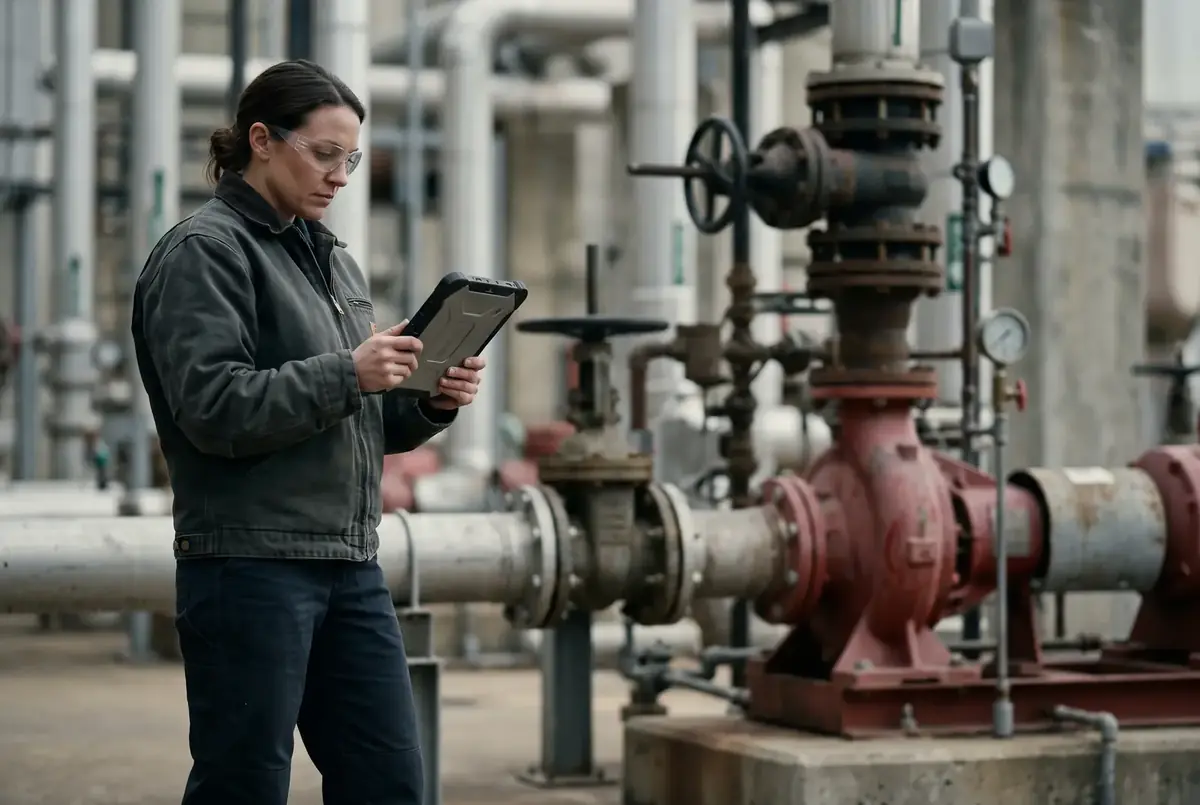
VULKRON Engineers answer your fire and electrical questions, from start-up and throughout operation, with no permanent staff stationed at your plant.
They set up your equipment in the system and propose your routines; your plant approves.
They train whoever runs VULKRON at your plant.
They review a drawing, a calculation, or what the standard or your insurer requires.
Engineering work, such as an arc flash study, is quoted separately.
You don't have to hire a specialist engineer to sustain your program.
Licensed per site, not per user.
VULKRON Enterprise is quoted to fit your equipment and your sites.
You start with fire or electrical and add the other when you need it. With multiple plants, Enterprise PRO manages them together.
Integrates with SAP, Oracle, IBM Maximo and others, as agreed.
How it starts at your plant
Your equipment
Loaded from your Excel or CSV file; your plant approves each entry.
Your routines
Each asset gets its routines and its calendar.
Training
Your people complete the general level of VULKRON STUDY.
Your contractors
They join at no cost, with access only to what your plant assigns them. If you change contractors, the logbook stays with you: how it is protected.
The first round
It starts with the first routine in the app.
VULKRON STUDY
Help your people understand why the routines exist.
The general level of VULKRON STUDY is included with Enterprise.
More about VULKRON
Why prevention matters
Before a serious accident there are minor incidents. What they signal and how to address them.
Prevention
Information security
Access, encryption and data ownership: what IT will ask, answered.
Security and data
The field app
The app technicians use to receive and carry out their routines at the plant.
View the app
Blog
How a fire protection or electrical system is tested, and how often.
Go to the blog
Contact
For a demo, a quote or a technical question.
ContactPrevention is not declared. It is governed.
See it working before you decide.
A demo with sample data, at the pace of your questions. If you like what you see, the next step is the on-site survey at your plant.